Five final PDF booksThe complete D2C collection
Five books · one complete operating pathway
From first idea to repeat order. Build the whole D2C system.
Five practical playbooks for the decisions between product idea and repeat revenue: category, launch, Meta, money and retention.
- Choose a category and promise people can remember.
- Launch and acquire demand with a clearer learning system.
- Protect contribution and design the next customer order.
Five final PDFs · one-time digital access · educational material

5final digital books
71practical chapters
5decision areas
PDFone-time digital format
71 practical chaptersVisible curriculum before purchase
Original visual frameworksDecision maps, prompts and tools
Clear educational scopeNo guaranteed-result claims
The visual shorthand
Five decisions. One connected system.
Each symbol gives a big subject a memorable shape—so the complete pathway is easier to see, revisit and apply.
CategoryIdea → Category
LaunchProduct → Offer
MarketingSignal → Scale
MoneyRevenue → Cash
RepeatFirst order → Lifetime
The honest reality
Building a D2C brand feels harder when every decision lives in a different tab.
The expensive part is rarely a lack of advice. It is the missing order between category, offer, creative, contribution and repeat purchase.

Category blur
A broad audience creates a product that is easy to compare and hard to remember.
Launch without proof
Packaging and ads arrive before the promise, page and objections are ready.
Marketing guesswork
More campaigns create more activity without creating a stronger learning loop.
Growth without cash
Revenue looks healthy while contribution, inventory and repeat remain unclear.
Your complete pathway
Five books. One desk-ready D2C operating system.
Read the complete route or start at today’s bottleneck. Every book connects its decision to what comes before and after it.

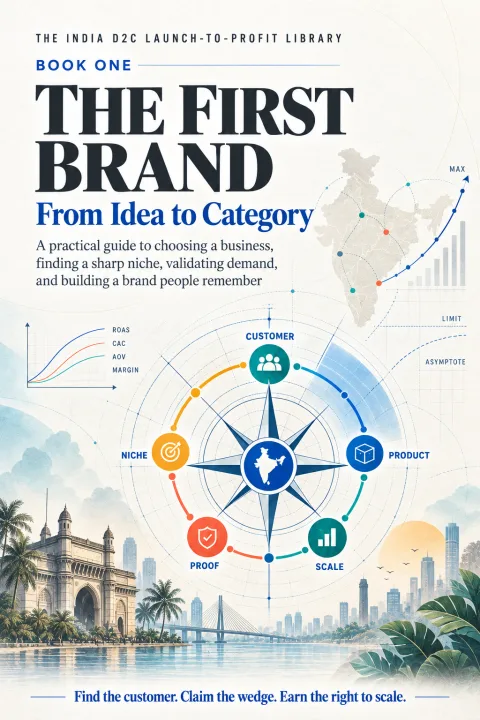
01 · Foundation
The First Brand
Idea → Category Open this book ↗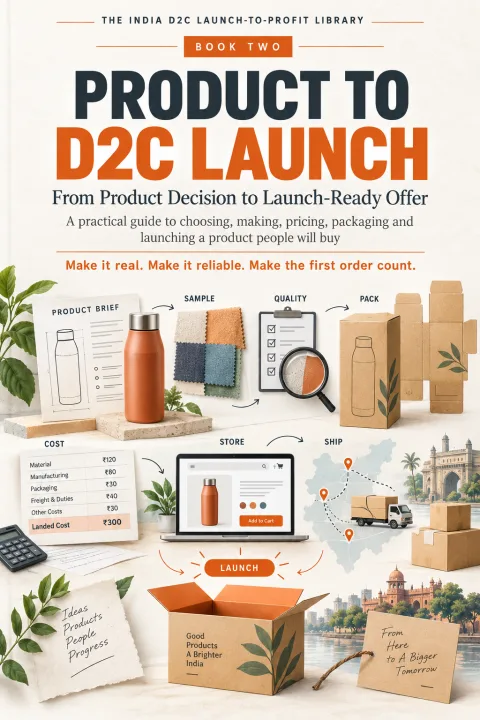
02 · Launch
Product to D2C Launch
Product → Offer Open this book ↗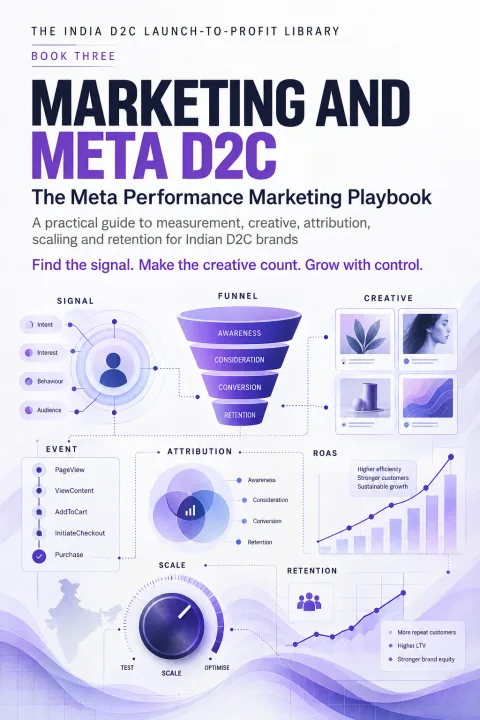
03 · Demand
Marketing and Meta D2C
Signal → Scale Open this book ↗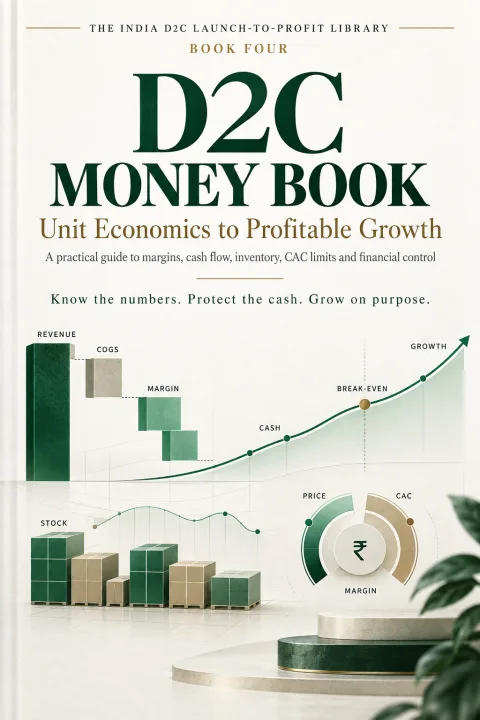
04 · Discipline
D2C Money Book
Revenue → Cash Open this book ↗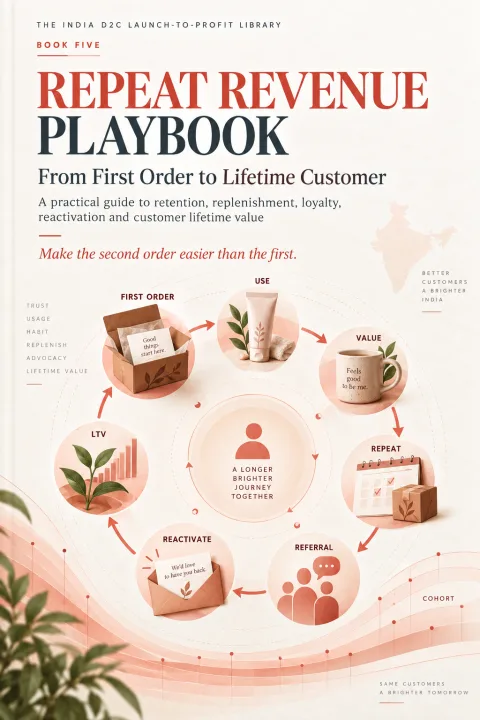
05 · Compounding
Repeat Revenue Playbook
First order → Lifetime Open this book ↗What is inside
Every chapter, organised by the decision it helps you make.
Open each book to inspect its complete chapter pathway before choosing.
01
 Foundation · 13 chaptersThe First Brand — From Idea to CategoryChoose what to build, define the niche and create a memorable reason to exist.
+
Foundation · 13 chaptersThe First Brand — From Idea to CategoryChoose what to build, define the niche and create a memorable reason to exist.
+
- 01The real beginning of a business
An idea is a possibility in your head.
- 02What business are you actually building?
Before you choose a category, identify the engine of value.
- 03India is not one market
The Indian digital market is large, but its size can tempt founders into lazy generalisation.
- 04How to choose a category and a niche
A category is a broad field: skincare, fashion, food, home décor, electronics or education.
- 05From idea to evidence
Not all signals are equal. Build evidence in layers.
- 06Differentiation: becoming the obvious choice
A different logo is not differentiation.
- 07Building a brand story that does a job
A founder’s journey may be interesting. It does not automatically explain why a customer should care.
- 08Product quality is the first marketing channel
A strong advertisement can create a first order. It cannot create durable trust when the product repeatedly disappoints.
- 09The economics and risks of a first launch
Revenue tells you how much money came in before many costs were removed. It is useful, but it can create false confidence.
- 10What Indian brands teach us about being remembered
The examples in this chapter do not share a product category. They share a strategic discipline.
- 11The one-page brand thesis
At the end of Book One, you should be able to describe the business without a presentation deck.
- 12Your first 30 days
Write three possible business ideas. Do not choose the winner yet.
- 13Practical worksheets and checklists
Includes a practical worksheet for applying this chapter.
02
 Launch · 14 chaptersProduct to D2C LaunchTurn product thinking into a credible offer, page and first-customer path.
+
Launch · 14 chaptersProduct to D2C LaunchTurn product thinking into a credible offer, page and first-customer path.
+
- 01A product is a promise made physical
A product is what the customer receives. An offer is the complete reason to choose it: the problem it addresses, the outcome it promises, the proof that makes the promise believable, the price, the delivery experience and the confidence that a mistake will be handled fairly.
- 02Start with a product brief, not a catalogue
Founders often ask a supplier for “a range” before they know which customer or use case the range should serve. The supplier responds with dozens of colours, sizes, materials and existing designs. Variety feels like progress because it produces choices.
- 03Category, format and specification
Customers bring a mental comparison to every purchase. A face cleanser is compared with other cleansers. A kurta is compared with other kurtas. A storage box is judged against the space, lid, material and use habits customers already know.
- 04Source, make or partner
There are three broad ways to bring a product to market:
- 05Prototype, sample and quality gate
A first sample can be excellent because it received unusual attention. A quality gate asks whether the product remains acceptable when the process is repeated, packed, transported and used by someone who was not part of the design.
- 06Claims, safety and category gates
Claims can create demand, but they also create obligations. “Chemical-free,” “cures,” “clinically proven,” “organic,” “safe for everyone,” “non-toxic,” “faster” and “guaranteed” are not interchangeable with a brand’s creative tone. They may require evidence, specific wording or category review.
- 07Packaging is part of the product experience
Packaging must protect the product, communicate what it is, help the customer use it and make the brand recognisable. A beautiful package that arrives damaged has failed. A functional pack that hides the most important information has also failed.
- 08Know the landed cost before you set the price
The price quoted by a supplier is only one part of the cost of having a saleable unit ready for a customer.
- 09Price the offer, not only the unit
Customers do not buy a cost sheet. They compare the expected value and risk of your offer with alternatives. The price must be supported by what the product does, how clearly it is explained, what proof is available and how safe the purchase feels.
- 10Create the product page as a decision system
A product page is not a brochure. It is a sequence that helps a visitor answer:
- 11Fulfilment, payments, support and returns
Customers do not separate the item from the journey that brings it to them. A late order, unclear update, damaged box or difficult return changes their judgement of the brand.
- 12Earn the first orders with a controlled launch
The first launch should answer a small number of questions:
- 13Decide what to improve before you scale
When performance is weak, repair in this order:
- 14Practical worksheets and checklists
Evidence required before purchase order:
03
 Demand · 16 chaptersMarketing and Meta D2CConnect message, creative and Meta decisions to customer response.
+
Demand · 16 chaptersMarketing and Meta D2CConnect message, creative and Meta decisions to customer response.
+
- 01The signal is the strategy
An Ads Manager report is not the business. It is a set of measurements produced by a tracking setup, a platform model, a time window, an attribution setting and a collection of customer behaviours. The number is useful only when you know what it represents.
- 02Write the measurement contract
“Sales” might mean a platform-reported purchase, a paid order, a fulfilled order, or recognised net revenue after cancellations and returns. “CAC” might mean spend divided by platform purchases, all marketing spend divided by new customers, or a planning assumption.
- 03Know the buying temperature
One person has never heard of the category. Another knows the category but has not seen your brand. A third has compared products and is checking delivery, fit, price or proof. A previous buyer may need a reminder, a replenishment cue or a better reason to return.
- 04Creative is the targeting layer
An attractive asset can win attention from people who will never need the product. A useful creative makes the category, situation or outcome recognisable early enough for the right viewer to continue.
- 05Turn an offer into a reason to act
People do not buy a product in a vacuum. They buy a product with a price, a quantity, a delivery promise, a risk level, a payment method, a support expectation and a picture of what happens after the purchase.
- 06Build the page after the promise
The person who clicks is asking for a more complete answer. The page should continue the promise they just saw, not make them restart the discovery process.
- 07Give every campaign one job
Before choosing an objective or structure, write the job in one sentence:
- 08Make the account readable
An account that cannot be understood by someone other than its creator is expensive to operate. Use consistent names for campaign, ad set, ad, product, market, funnel role, creative concept and date where useful.
- 09Protect the event chain
An event should mean one thing, arrive once where possible, carry the fields needed for the decision, and be testable. A purchase is not simply a page load. It should be connected to an order outcome and a sensible value.
- 10Treat attribution as a lens
An attributed purchase means the platform assigned credit under a defined method. It does not prove that the ad was the only reason the order happened. Organic discovery, direct visits, creator content, previous exposure, brand memory, price and customer urgency may all contribute.
- 11Let unit economics set the boundary
Revenue divided by ad spend can look attractive while the order loses money after product cost, packaging, shipping, payment fees, discounts, returns, support and taxes. A good ratio on a bad contribution margin is still a bad outcome.
- 12Read performance without panic
Ask five questions before changing a campaign:
- 13Scale the system, not the lucky day
Before increasing spend, ask whether the product, cash, inventory, customer support, dispatch capacity, payment flow and return handling can absorb more orders. Advertising can expose a constraint faster than the rest of the business can solve it.
- 14The click is not the customer
The customer may need a COD confirmation, an answer on WhatsApp, a size exchange, a delivery update, usage guidance or reassurance after the first use. These moments shape refunds, reviews, referrals and repeat orders.
- 15Build a weekly operating rhythm
Daily: health check. Spend pacing, broken links, disapprovals, checkout, payment, stock, support and unusual delivery changes.
- 16Practical worksheets and checklists
Includes a practical worksheet for applying this chapter.
04
 Discipline · 14 chaptersD2C Money BookRead CAC, contribution, inventory, cash and break-even together.
+
Discipline · 14 chaptersD2C Money BookRead CAC, contribution, inventory, cash and break-even together.
+
- 01Revenue is not money you can keep
Suppose the store records ₹10,00,000 in gross order value. That amount may include GST, discounts, shipping collected from customers, cancelled orders, COD orders that never become deliveries and orders that later return.
- 02Build the order economics
The order-level model is the smallest useful financial unit. It should show what the customer paid, what was reduced, what it cost to make and serve the order, what acquisition cost was carried by the order and what remains.
- 03Know your contribution margin
At the beginning of a D2C brand, the most useful question is often not “what is the accounting profit this month?” It is:
- 04Price from the business backwards
Price signals position, controls contribution, affects conversion, changes return expectations and determines how much room exists for acquisition. It should be considered alongside product, proof, packaging, service and channel fees.
- 05Discounts need a job
A discount can help a first purchase, clear a seasonal stock position, increase a bundle, reward a customer, compensate for a service recovery or test price sensitivity. It can also train buyers to wait, hide weak value and remove the contribution needed for growth.
- 06CAC is a boundary, not a badge
CAC can mean total paid-media spend divided by new customers, a campaign’s spend divided by recorded purchases, or all sales and marketing costs divided by first-time customers. Use the version that matches the decision and name it.
- 07AOV and the shape of the basket
AOV can rise because customers buy more, because the brand sells more expensive products, because a discount threshold changes the basket, or because a small number of large orders distort the average.
- 08Cash arrives on a different clock
A product may be sold today, remitted by a gateway later, delivered by a courier after another delay and returned weeks after that. Inventory may have been paid for before the first advertisement ran. Tax and supplier obligations may arrive on a different schedule.
- 09Inventory is money wearing a product label
Inventory has a purchase cost, a holding cost, a risk of damage or obsolescence, a storage footprint and a cash opportunity cost. It becomes useful when it turns into a sale that creates enough contribution.
- 10COD, returns and leakage
Indian D2C brands may face COD confirmation, failed delivery, RTO, exchanges, partial refunds, gateway reversals and customer support effort. These are operating realities that belong in the model.
- 11Forecast with scenarios
A good forecast does not predict the future with confidence. It shows what would happen if the important assumptions were different.
- 12Decide what growth can afford
A brand can spend on awareness, acquisition, inventory, people, technology, creative, packaging, discounts, support and new products. The order matters because each decision uses cash and management attention.
- 13Build a monthly money room
Hold one monthly review with the order economics, channel performance, inventory, cash forecast and customer outcomes visible together.
- 14Practical worksheets and checklists
Includes a practical worksheet for applying this chapter.
05
 Compounding · 14 chaptersRepeat Revenue PlaybookBuild the experience, replenishment and loyalty loop behind the next order.
+
Compounding · 14 chaptersRepeat Revenue PlaybookBuild the experience, replenishment and loyalty loop behind the next order.
+
- 01The first order is an introduction
A customer’s relationship with the brand begins to become real after the order. The confirmation message, delivery estimate, support response, unboxing, instructions, first use and remedy for a problem all influence whether the customer forms a positive memory.
- 02Design the moment after payment
After payment, the customer often wonders: Was the order successful? When will it arrive? Can I change the address? What exactly did I buy? What should I do when it comes?
- 03Deliver the promised first value
A product can be excellent and still feel disappointing if the customer does not know where to begin. Onboarding removes the gap between receiving the item and experiencing the intended outcome.
- 04Find the natural reason to return
A consumable may be replenished. Apparel may be expanded by occasion or season. A home product may lead to a complementary purchase. A gift brand may return around festivals or life events. A service may renew when the customer reaches a milestone.
- 05Build a replenishment rhythm
A reminder should arrive near the customer’s likely need, not at an arbitrary interval chosen because a calendar entry exists. The estimate can use quantity, usage frequency, product type, household size, stated preference and past orders, but it should remain an invitation rather than an assumption.
- 06Create the next-best offer
“Customers also bought” can be useful, but a more helpful recommendation explains the relationship: use together, buy after, choose for a different occasion, increase quantity, or solve the next step.
- 07Use service as a retention channel
A delayed order, wrong size, damaged pack, payment problem or product question is a moment when the customer decides whether the brand behaves fairly. Good service cannot make every failure disappear, but it can make the response predictable and respectful.
- 08Make loyalty feel earned
Points are only one mechanic. Loyalty can come from access, recognition, helpful education, early notice, personalisation, a better bundle, service priority, community or a product that consistently does its job.
- 09Ask for referrals at the right moment
A customer risks their own reputation when they recommend a brand. Ask after a clear value moment, not immediately after payment and not while an unresolved complaint is open.
- 10Reactivate without begging
A customer may have enough stock, changed location, changed preference, had a bad experience, forgotten, lost access to the channel, or simply not need the product now. Treat inactivity as a question to investigate, not a character flaw.
- 11Read cohorts, not anecdotes
A single customer story can reveal a useful possibility. It cannot tell you how the customer base behaves. Group customers by a meaningful shared condition and compare their behaviour over time.
- 12Measure customer value honestly
Customer lifetime value is an estimate of future value based on observed behaviour and assumptions. It becomes misleading when it counts uncollected revenue, ignores returns, assumes every customer repeats, or uses a long future period to justify today’s spend.
- 13Build the retention operating system
Product, fulfilment, support, marketing, finance and data each see a different part of the customer experience. Assign an owner for the retention system and invite the functions that can change the causes, not only the messages.
- 14Practical worksheets and checklists
Includes a practical worksheet for applying this chapter.
The complete skill route
Master the five decisions that turn activity into an operating system.
Five connected capabilities, each supported by a dedicated practical book.
Category
Choose the customer, tension and memorable wedge before the product becomes generic.
Launch
Connect product, proof, page and offer before paying to create demand.
Marketing
Use customer, creative and Meta signals to decide what to test next.
Money
Read CAC, contribution, inventory and cash as one growth decision.
Repeat
Design the first experience around the next order, referral and retention loop.
An inside look
The complicated parts are already visualised.
Original diagrams and decision maps make the sequence visible across customer, product, media, cash and retention.




The full scope
One bundle, the whole launch-to-profit journey.
A complete pathway from what to build to why customers return.
1bundle
→5books
→71chapters
→5decision areas
01The First Brand→02Product to D2C Launch→03Marketing and Meta D2C→04D2C Money Book→05Repeat Revenue Playbook
Who this is for
Built for operators who want fewer disconnected answers.
Use this check before deciding whether the complete route belongs on your desk.
A strong fit if…
- You have an idea but not yet a complete business route.
- You have a product but the launch or Meta system feels unclear.
- You want contribution and cash in the same conversation as growth.
- You want repeat purchase designed before the first-order novelty fades.
Not a fit if…
- You want guaranteed income from reading a book.
- You are looking for one viral-product or ad hack.
- You are unwilling to test decisions with real customers and numbers.
Simple digital pricing
Choose one decision—or keep the complete system.
The bundle is the complete five-book pathway. Single-book pages stay available when you only need one focused decision.
One book
₹499
- Choose any one final PDF
- One focused decision route
- Frameworks, prompts and checklists
- One-time digital access
Five-book bundle
₹999₹2,499
bundle offer
bundle offer
- The First Brand
- Product to D2C Launch
- Marketing and Meta D2C
- D2C Money Book
- Repeat Revenue Playbook
Got questions?
Clear answers before you choose the bundle.
No inflated promises—only what the collection contains and how it is intended to work.
What exactly do I receive?+
Five final PDF playbooks covering category and brand, product launch, marketing and Meta, D2C money and repeat revenue.
Should I read the books in order?+
The sequence is designed to connect, but you can begin with the bottleneck in front of you and return to the complete route when needed.
Is this useful before I launch?+
Yes. The first two books focus on decisions that come before inventory, packaging, ads and launch execution.
Does this guarantee business results?+
No. The bundle is educational material and a decision framework. Results depend on product, market, execution, resources and customer response.
How will the books be delivered?+
Digital delivery is intended after checkout. Payment and fulfilment will be connected before the offer is opened for purchase.
Limited-period bundle offer
Make the next D2C decision with the whole system in view.
Five final digital books · ₹2,499 standard collection value · ₹999 bundle offer.