Five final PDF booksThe complete money collection
Five books · one complete money pathway
From this month’s money to long-term wealth. Build the complete system.
Five plain-language books for organising money, using credit wisely, investing with context, planning retirement and building future choice.
- Build a monthly money system you can actually repeat.
- Use credit and investing with goals, time and risk in view.
- Connect retirement and wealth to practical decisions today.
Five final PDFs · one-time digital access · educational material

5final digital books
47practical chapters
5decision areas
PDFone-time digital format
47 practical chaptersVisible curriculum before purchase
Original visual frameworksDecision maps, prompts and tools
General educationNot personal financial advice
The visual shorthand
Five decisions. One connected system.
Each symbol gives a big subject a memorable shape—so the complete pathway is easier to see, revisit and apply.
The monthClarity → Control
CreditCredit → Value
InvestingGoal → Growth
RetirementDate → Future
WealthHabits → Optionality
The honest reality
Money feels complicated when every decision arrives without a system.
The expensive part is not a shortage of advice. It is the missing order between the month, debt, goals, investing, protection and the future.

Monthly fog
Income arrives, expenses happen and the month closes without a visible plan.
Credit confusion
Rewards and offers distract from payment discipline, utilisation and flexibility.
Investment noise
Products arrive before goals, time horizon and risk are understood.
A distant future
Retirement and wealth remain abstract because the next practical step is missing.
Your complete pathway
Five books. One calmer personal money system.
Read the complete route or start with today’s decision. Every book connects everyday behaviour to longer-term choice.


01 · Foundations
Money Management
Clarity → Control Open this book ↗
02 · Everyday leverage
Smart Credit Cards
Credit → Value Open this book ↗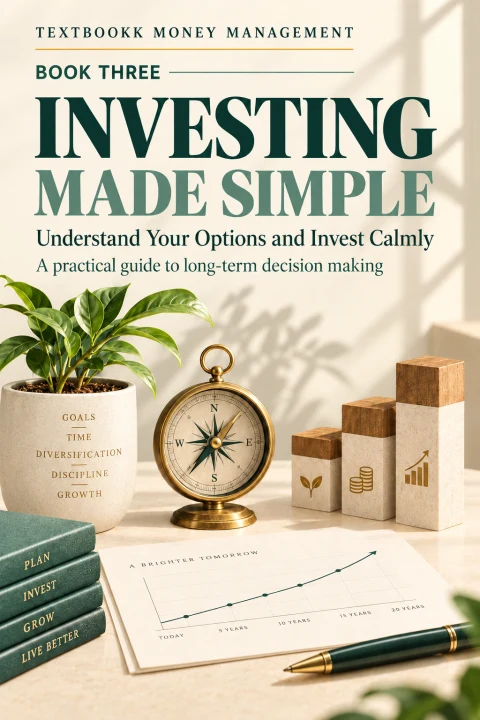
03 · Long-term growth
Investing Made Simple
Goal → Growth Open this book ↗
04 · Future income
Retirement Planning
Date → Future Open this book ↗
05 · Compounding
Building Wealth
Habits → Optionality Open this book ↗What is inside
Every chapter, organised by the decision it helps you make.
Open each book to inspect its complete chapter pathway before choosing.
01
 Foundations · 9 chaptersMoney Management Made SimpleBuild a monthly system for earning, spending, saving and planning.
+
Foundations · 9 chaptersMoney Management Made SimpleBuild a monthly system for earning, spending, saving and planning.
+
- 01Money is a system
Money becomes stressful when every decision is made in real time. Should you say yes to the trip? Can you replace the phone? Is the subscription worth it? A system gives those decisions a home.
- 02Build your baseline
Your baseline is a simple picture of a normal month. It does not need to capture every rupee. It needs to reveal the decisions that matter.
- 03Make saving automatic
Saving fails when it is treated as a leftover. A better design is to move the future amount shortly after income arrives, then operate the month from what remains.
- 04Protect the floor
The floor is the amount of safety beneath your normal life. It is the layer that absorbs a delayed payment, an urgent repair, a job transition or a family need without forcing an expensive decision.
- 05Make debt visible
Debt becomes harder when it is described only as a monthly EMI. Write down the outstanding balance, interest or cost, minimum payment, due date and the consequence of missing it. Visibility turns an anxious cloud into a set of decisions.
- 06Turn goals into funded plans
A goal becomes practical when it has a date, an amount, a current starting point and a monthly action. “I want to travel” is a wish. “I want ₹60,000 available by December, and I will move ₹7,500 a month from April” is a plan.
- 07Make the household a team
Many money problems are coordination problems. One person assumes a fee is covered. Another assumes the trip is already funded. Both are surprised.
- 08Run a monthly reset
The monthly reset is a 20-minute meeting with your own system. Look at actual spending, upcoming commitments, debt payments, reserves and goal transfers. Pick one adjustment only. A system that improves one line every month becomes more useful than a perfect system abandoned after one week.
- 09Your 30-day money reset
Days 1–3: See it. Collect statements, recurring payments, debt details and annual expenses. Do not change everything yet.
02
 Everyday leverage · 9 chaptersSmart Credit CardsUse credit carefully, protect flexibility and make rewards useful.
+
Everyday leverage · 9 chaptersSmart Credit CardsUse credit carefully, protect flexibility and make rewards useful.
+
- 01Credit is a tool
A credit card does not create extra income. It changes the timing of payment. You receive convenience, tracking and possibly rewards today; the issuer expects repayment under the card agreement later. The tool is useful when your repayment plan is stronger than your impulse to spend.
- 02Read the billing cycle
Three dates matter: the transaction date, the statement date and the payment due date. A purchase can appear in a statement after the day you made it. A payment notification can arrive before the statement is fully understood. Learn your own cycle by reading one complete statement from top to bottom.
- 03Choose for fit, not excitement
Start with your real spending pattern: groceries, fuel, travel, online shopping, utilities or business expenses. A card is useful when the rewards are attached to spending you would make anyway and the total cost of ownership makes sense.
- 04Do the rewards maths
Rewards are not free money. They are a rebate with conditions. Calculate the net value you realistically expect to redeem, then subtract the annual fee and any extra spending the card encourages.
- 05Build repayment into the system
The strongest card habit is to treat every card purchase as already spent. Keep a running card reserve in your bank balance or budget. When the statement closes, the amount should not feel like a surprise.
- 06Protect the record
Credit records are built from patterns over time. On-time payments, responsible utilisation, accurate information and restrained new applications are generally healthier signals than repeatedly stretching the limit. Exact scoring methods are set by the relevant bureau and can change; treat this book as a set of behaviours, not a scoring formula.
- 07EMIs and big purchases
An EMI makes a large purchase look smaller by spreading the payment. It does not make the purchase cheaper. Before choosing one, write down the total amount payable, fees, interest, processing charges, foreclosure rules, tenure and the monthly payment.
- 08Fraud, disputes and mistakes
When something looks wrong, slow down and document it. Capture the date, amount, merchant, alert and communication reference. Contact the issuer through an official channel and follow its dispute process. Keep records until the matter is closed.
- 09Your annual card audit
Once a year, list every card, fee, due date, limit, reward balance, active EMI, linked auto-debit and reason for keeping it. Close or change products only after understanding the effect on current instalments, rewards, access and credit history.
03
 Long-term growth · 10 chaptersInvesting Made SimpleUnderstand goals, time, risk and diversification in plain language.
+
Long-term growth · 10 chaptersInvesting Made SimpleUnderstand goals, time, risk and diversification in plain language.
+
- 01Saving and investing are different jobs
Saving protects near-term choices. Investing gives long-term money a chance to grow, while accepting uncertainty. The two jobs often sit next to each other, but they should not be confused.
- 02Risk has more than one meaning
Risk is not only the chance that a price moves down. It can also be the chance that money is unavailable when needed, that inflation reduces purchasing power, that a promise is not met, that costs consume returns, or that your own behaviour forces a bad decision.
- 03The main asset families
Cash and deposits can be simple and accessible, but their returns, tax treatment and purchasing power need context. Debt instruments generally involve lending money under defined terms, with credit and interest-rate risks. Equity represents ownership and can be volatile. Real estate is physical and often illiquid, with transaction and maintenance costs. Gold and commodities may diversify but do not behave like a guaranteed hedge. Alternatives can be complex and less liquid.
- 04Diversification is a behaviour
Diversification is not collecting many products. It is avoiding dependence on one outcome. Two funds may hold similar companies. Three properties may expose one neighbourhood. Ten stocks may still belong to one sector. Look through labels to the underlying exposures.
- 05Mutual funds and index funds
A mutual fund pools money from multiple investors and invests according to its mandate. An index fund generally aims to track a defined index rather than select investments through active judgement. Both need to be understood through their objective, holdings, costs, tracking or management approach, liquidity, risk and tax treatment.
- 06Fixed income with eyes open
Fixed income products may offer defined terms, but “fixed” does not mean “risk-free”. Consider issuer quality, maturity, reinvestment risk, interest-rate sensitivity, access, deposit or product protections where applicable, and tax treatment. A deposit and a bond are not the same instrument.
- 07Gold, property and alternatives
Gold can be held in different forms, each with its own cost, liquidity, tracking and storage considerations. Property can serve a home, income or investment role, but it also carries concentration, maintenance, vacancy, legal and transaction risks. Alternatives may offer a different return pattern but often require deeper due diligence.
- 08The investor is part of the portfolio
A plan can fail because the investor sells in fear, chases a recent winner, invests money needed soon or keeps changing the rules. Behaviour is an asset-allocation decision in disguise.
- 09Write a simple investing plan
The written plan should fit on one page: goals and dates; current starting point; emergency and near-term money; preferred level of complexity; broad roles for assets; contribution rhythm; review dates; and the situations that justify a change.
- 10Review without reacting
Review when the goal, time horizon, income, obligations or asset role changes—not simply because a price moved. Keep a decision log: what changed, what you considered, what you did and why. The log makes hindsight less persuasive.
04
 Future income · 9 chaptersRetirement Planning Made SimpleTurn a future income goal into a visible plan and next step.
+
Future income · 9 chaptersRetirement Planning Made SimpleTurn a future income goal into a visible plan and next step.
+
- 01Retirement is a cash-flow problem
Retirement planning is not only about reaching a large number. It is about building a future where money can arrive as your work income reduces or stops, while your life continues to need housing, food, healthcare, family support, maintenance and meaning.
- 02Define the future
Two households with the same salary can need different retirement plans. One may own a home and support no dependants. Another may rent in a high-cost city and support parents. Neither is more correct.
- 03Estimate spending without pretending to know everything
Group current spending into housing, food, transport, healthcare, family support, insurance, lifestyle, taxes or fees and irregular costs. Remove expenses that may stop; add costs that may begin. Then create a low, middle and high scenario.
- 04Inflation and the funding gap
The amount that feels sufficient today may buy less later. You do not need to predict an exact future price to take the idea seriously. Use scenarios and review them.
- 05Map future income
List potential sources separately: employment or consulting, business income, rental income, deposits or fixed-income cash flow, pensions or annuity-like arrangements, government benefits where applicable, and withdrawals from long-term assets. Each has different uncertainty, access, tax treatment and maintenance.
- 06Build during the accumulation phase
Accumulation is the period when you convert present income into future options. The habit needs three qualities: it is automatic, it is diversified across the roles your plan needs and it is reviewed when life changes.
- 07Protect the plan
Health costs and family responsibilities can change a retirement plan quickly. Review health cover, life cover where someone depends on your income, emergency liquidity, important documents and the people who know how to access them.
- 08Nominees, documents and family conversations
A financial plan that only one person understands is fragile. Organise account lists, policy details, property documents, loan information, passwords through a secure method, nominee details and instructions for emergencies. Legal succession rules can be complex; use qualified legal help when needed.
- 09The transition to drawing
The move from salary to portfolio or pension income is a change in rhythm. Before it happens, build a cash-flow calendar: essential monthly costs, annual costs, healthcare reserves, flexible spending and the sources expected to fund each.
05
 Compounding · 10 chaptersBuilding Wealth Over TimeGrow, protect and use money well without chasing shortcuts.
+
Compounding · 10 chaptersBuilding Wealth Over TimeGrow, protect and use money well without chasing shortcuts.
+
- 01What wealth is for
Wealth is stored choice. It can buy time, reduce dependence on a fragile income, support family, fund meaningful work or make a difficult season less dangerous. A large number without liquidity, health or control may not feel wealthy.
- 02The compounding engine
Compounding needs time, contributions, reasonable costs, patience and a plan that stays invested or productive according to its role. It is not a magic rate. A higher expected return generally comes with more uncertainty, and past performance does not guarantee future results.
- 03Earn more, keep more
Wealth building is not only an investing exercise. It is also a household income system. Build valuable skills, negotiate thoughtfully, create a second income stream only when the economics are clear and protect the time needed to sustain your main work.
- 04Protect the capital
Protection is a return. It prevents one event from undoing years of progress. Review liquidity, insurance, debt exposure, concentration, fraud protection, legal documents and the reliability of income.
- 05Thinking about ₹1 crore
A large sum creates possibilities, but it does not automatically create a safe monthly income. The answer depends on the required spending, inflation, taxes, fees, liquidity, the source of the capital, the time horizon and the risk you can actually withstand.
- 06Friction: taxes, fees and structure
Friction is what quietly reduces the money that can keep working. It includes product fees, transaction costs, taxes, penalties, borrowing costs, idle cash and the cost of complexity.
- 07Purposeful spending
A plan that never allows enjoyment becomes brittle. Purposeful spending is chosen, funded and aligned with the life you value. It is different from spending to relieve stress or prove status.
- 08Concentration and second-order risk
Concentration can be obvious—one stock, one property, one business—or hidden in correlated assets, one employer, one customer or one city. Ask what would happen if the same shock affected several parts of your life at once.
- 09Family systems
Wealth that depends on one person’s memory is fragile. Create a family map of accounts, insurance, property, loans, nominees, important contacts and the location of key documents. Store sensitive information securely. For legal succession, use qualified legal support.
- 10Your 12-month wealth operating system
Quarter 1: baseline income, spending, reserves and liabilities.
The complete skill route
Master the five decisions that make money easier to see and use.
Five connected capabilities, each supported by a dedicated practical book.
The month
Give earning, spending, goals and reserves a visible order.
Credit
Keep payment discipline and flexibility ahead of rewards and offers.
Investing
Match goals, time horizon and risk before choosing a route.
Retirement
Turn a distant future into an income need, timeline and next contribution.
Wealth
Build reserves, protection, ownership and optionality in the right sequence.
An inside look
The complicated choices are already visualised.
Original decision maps make monthly money, credit, investing, retirement and compounding easier to connect.




The full scope
One bundle, the whole money journey.
A complete pathway from monthly control to long-term optionality.
1bundle
→5books
→47chapters
→5decision areas
01Money Management→02Smart Credit Cards→03Investing Made Simple→04Retirement Planning→05Building Wealth
Who this is for
Built for people who want fewer confusing money decisions.
Use this check before deciding whether the complete route belongs on your desk.
A strong fit if…
- You want a simple way to organise monthly money.
- You use cards or rewards but want more control.
- You are beginning to invest or plan retirement.
- You want wealth-building habits instead of shortcuts.
Not a fit if…
- You want guaranteed returns or instant wealth.
- You are looking for a personal investment recommendation.
- You are unwilling to review your own income, goals and risk.
Simple digital pricing
Choose one decision—or keep the complete system.
The bundle is the complete five-book pathway. Single-book pages stay available when you only need one focused decision.
One book
₹499
- Choose any one final PDF
- One focused decision route
- Frameworks, prompts and checklists
- One-time digital access
Five-book bundle
₹999₹2,499
bundle offer
bundle offer
- Money Management
- Smart Credit Cards
- Investing Made Simple
- Retirement Planning
- Building Wealth
Got questions?
Clear answers before you choose the bundle.
No inflated promises—only what the collection contains and how it is intended to work.
What exactly do I receive?+
Five final PDF books covering monthly money management, credit cards, investing, retirement planning and building wealth.
Is this personal financial advice?+
No. It is general educational material and a set of frameworks for understanding your own decisions. It is not a recommendation to buy or sell a financial product.
Should I read the books in order?+
The sequence is connected, but you can begin with the money decision in front of you and return to the complete route when needed.
Does this guarantee returns or wealth?+
No. Outcomes depend on income, goals, time horizon, choices, market conditions and execution.
How will the books be delivered?+
Digital delivery is intended after checkout. Payment and fulfilment will be connected before the offer is opened for purchase.
Limited-period bundle offer
Make the next money decision with the whole system in view.
Five final digital books · ₹2,499 standard collection value · ₹999 bundle offer.